
 Luis Cajas
Fluid Delivery Face-Off: Fluid Metering vs. Solenoid Pumps
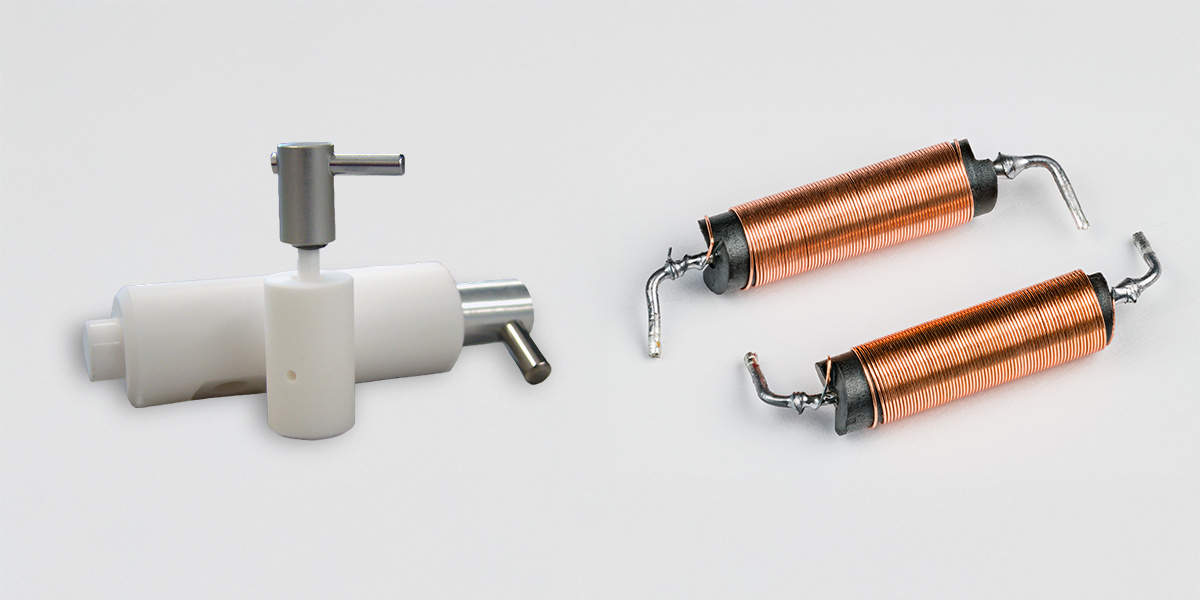
Let's explore how the notable differences between Fluid Metering pumps and solenoid pumps fair when they face off in key application scenarios.
.png)
Magnetic beads used in life science applications — from superparamagnetic iron oxide nanoparticles (SPIONs) in NGS workflows to larger beads for cell isolation — typically range from 150 nm up to 4.5 µm in diameter. Their small size, abrasive coatings, and strong magnetic properties make them notoriously difficult to move through conventional pumps without degrading performance, losing sample, or destroying equipment.
The challenges cluster around six core failure modes:
|
Magnetic Clumping Beads attract to metallic components and drive magnets, forming dense clumps that block flow paths or seize impellers. |
Abrasive Wear Silica or polymer coatings act as grinding paste in tight tolerances, rapidly destroying bearings, bushings, and seals. |
|
Drive Decoupling In mag-drive pumps, seized impellers cause the magnetic coupling to slip — the motor spins while the pump head stalls silently. |
Sample Loss Drive magnets permanently trap beads inside the pump head, reducing recovery yield and destroying batch concentration accuracy. |
|
Heat & Demagnetization In mag-drive pumps, seized impellers cause the magnetic coupling to slip — the motor spins while the pump head stalls silently. |
Bead Settling Static or low-shear pumps let beads sediment in lines and heads, causing concentration drift and inconsistent dosing. |
How Pump Types Compare
Different pump technologies handle these challenges with widely varying results. The table below summarizes how four common alternatives stack up against FMI piston technology across the failure modes that matter most.
| Pump Type | Clog Risk | Bead Trapping | Keeps Beads Suspended | Dosing Accuracy | Verdict |
| Magnetic Drive | Very High | High | No | Moderate | Avoid |
| Gear Pump | High | Moderate | No | Good | Not Recommended |
| Peristaltic Pump | Low | None | Partial | Moderate | Good Alternative |
| Syringe Pump | Low | None | Poor | Good | Volume-limited |
| Diaphragm Pump | Moderate | Low | Partial | Moderate | Limited |
| FMI Piston Pump | Very Low | None | Yes — by design | Excellent | Recommended ✓ |
Gear Pumps and Magnetic Drives: the worst offenders
Both technologies present tight internal clearances that act as particle traps. Gear pumps grind abrasive bead coatings between metal teeth within thousandths of an inch. Magnetic drive pumps compound this with a secondary failure: the very drive mechanism that turns the impeller actively attracts and retains magnetic beads, permanently altering sample concentration.
Peristaltic Pumps: close, but not quite
Tubing pumps avoid internal bead contact entirely — fluid never touches pump components — making them a popular choice. However, peristaltic pumps deliver only moderate dosing consistency, and the intermittent squeeze-and-release action doesn’t actively re-suspend beads that settle in horizontal tubing runs. For precision dispensing at scale, they fall short.
Syringe Pumps: accurate but finite
Syringe pumps offer good precision but are limited by barrel volume and require refilling cycles. During the idle dwell time at the end of each stroke, beads can begin to sediment — particularly problematic in concentration-sensitive workflows. They also offer no mechanism for keeping beads in suspension during pauses.
Diaphragm Pumps: an honorable mention
Diaphragm pumps avoid the magnetic coupling failure mode and have no internal seals exposed to abrasive particles. However, their pulsating flow can create localized zones of low velocity where beads settle, and dosing repeatability lags behind positive displacement piston designs.
Why FMI Piston Technology Solves the Core Problems
The FMI Pump uses a rotating and reciprocating piston — a combined motion that continuously re-suspends particles with every stroke cycle, preventing sedimentation entirely. There are no internal magnets, no close-tolerance gear meshes, and no mechanical seals in the fluid path.
✓ No internal magnets. The drive mechanism is fully decoupled from any magnetic field in the fluid path, eliminating bead attraction, trapping, and agglomeration at the source.
✓ Handles particles up to 700 µm. FMI’s generous internal clearances have been validated for particles up to 700 microns — orders of magnitude larger than the 1–4.5 µm beads used in most life science workflows, providing a wide safety margin against clogging.
✓ Rotation + reciprocation keeps beads in suspension. The combined piston motion generates continuous gentle agitation throughout the stroke cycle, preventing sedimentation without the need for external mixing or ultrasonication.
✓ Exceptional dosing repeatability. As a true positive displacement technology, FMI delivers precise, repeatable fluid volumes per stroke — critical in NGS library prep and any bead-based assay where concentration must be controlled tightly.
✓ Chemically compatible wetted parts. PTFE and ceramic options resist abrasive bead coatings, extending service life and protecting sample integrity.
Particle size context — FMI’s 700 µm capacity vs. typical bead sizes
|
NGS beads (AMPure XP, Dynabeads MyOne) |
~1 µm |
| Cell isolation beads (Dynabeads 4.5) | 4.5 µm |
| Amogreentech application | < 0.04 µm |
| Human hair (reference) | ~70 µm |
| FMI validated capacity | 700 µm |
FMI’s 700 µm validated capacity exceeds all common life science bead sizes by a wide margin.
.png?width=1998&height=545&name=review%20image%20(4).png)
The Bottom Line
For any application where magnetic bead concentration, suspension consistency, and dosing precision are non-negotiable — NGS library prep, immunoassay automation, bioprocessing scale-up — the pump choice matters enormously. Magnetic drive and gear pumps are fundamentally incompatible with magnetic bead fluids. Peristaltic and syringe pumps offer partial solutions with real limitations. FMI’s piston technology, with its magnet-free design, wide internal clearances, and unique rotating-reciprocating action that keeps particles in suspension, is the only platform that addresses every failure mode simultaneously — and does so with best-in-class dosing accuracy proven in competitive head-to-head evaluation.

Let's explore how the notable differences between Fluid Metering pumps and solenoid pumps fair when they face off in key application scenarios.
Fluid Metering has now developed the FENYX Variable Dispense Pump. A breakthrough pump that can be used in place of most syringe pump applications.
Fluid Metering offers many solutions for metering different fluids at different flow rates, including our Duplex pumps. Learn more about these pumps...