
How Does Viscosity Impact the Accuracy of Pumps?
Learn how viscosity impacts pump accuracy and performance. Understand the importance of viscosity when selecting the right pump for your application.
5 min read
%20blog3.png)
Blogs I and II of this series examined how pump speed affects flow accuracy in analytical instruments and how speed control becomes part of the broader control strategy in continuous manufacturing. For viscous pharmaceutical formulations, that same relationship between pump speed and actual delivery introduces another consideration: whether the fluid can move through the system quickly enough to support the commanded speed.
As viscosity rises, the fluid resists movement through tubing, fittings, ports, and other restrictions. The pump may need more time to fill, more torque to move the fluid, and a more carefully defined speed range to maintain consistent delivery.
For process engineers and equipment designers, the objective is not simply to run the pump faster or slower. It is to identify an operating window in which the formulation can enter the pump completely, move through the fluid path without excessive resistance, and reach the process at the intended rate.
For a positive displacement pump, theoretical flow is determined by displacement and rotational speed. As discussed earlier in this series, however, theoretical flow is only the starting point. Actual delivery depends on the complete fluidic system.
With a viscous formulation, one key factor is whether enough fluid can enter the pumping chamber during each cycle. At higher speeds, less time is available for filling. If the formulation cannot move through the inlet path quickly enough, the chamber may not fill completely before discharge begins.
The commanded speed can continue to increase while delivered flow rises by less than expected or becomes less consistent.
The practical speed limit therefore depends on more than the motor. It is influenced by:
Increasing pump speed raises theoretical flow only while the fluidic system can support the resulting conditions.
A restrictive inlet can become the limiting factor before the motor reaches its maximum rated speed. This is why a maximum flow value established with water should be treated as a reference point rather than a prediction for a viscous formulation. Fluid characteristics and application conditions can change the relationship between pump speed and actual capacity.
The design goal is not maximum speed. It is to place the required flow range within an operating window that supports consistent filling, adequate torque, and appropriate control resolution.
The inlet side deserves particular attention because a positive displacement pump cannot deliver fluid that does not reach the pumping chamber.
Small tubing, long runs, sharp changes in direction, and restrictive fittings all increase resistance. Their effect becomes more pronounced as viscosity or required flow increases.
A viscosity-conscious inlet design may include:
Any inlet assistance should remain within pump and system pressure limits and should be evaluated under representative operating conditions.
Viscosity, flow, and pressure are closely connected.
As the pump moves a more viscous fluid through tubing, filters, nozzles, and other restrictions, the required differential pressure can increase. The motor must provide enough torque to maintain the commanded motion under that load.
Pressure capability alone, however, does not correct an inadequate inlet condition. A pump may be capable of operating against the required downstream pressure while still receiving too little fluid at the inlet when speed is too high.
For the intended operating window, confirm:
The result should be an operating range based on the actual system load, not simply individual pump or motor ratings.
A formulation's viscosity can change with temperature. If temperature varies between development, scale-up, startup, and steady-state operation, a speed that produces the intended flow during one test may not produce the same result under another condition.
Testing should therefore cover the expected temperature range rather than a single nominal point.
When temperature control or a heated pump head is used to improve fluid movement, engineers should also consider formulation requirements, wetted materials, seals, tubing, and equipment limits. The objective is to establish repeatable operating conditions, not simply to reduce viscosity as much as possible.
Formulation behavior also matters. If the formulation is sensitive to aeration, shear, separation, or crystallization, those effects should be evaluated at the proposed speed, temperature, and pressure conditions.
Speed control works best when pump displacement places the normal operating point within a practical portion of the motor's range.
Selecting a displacement that is too small can force a viscous formulation to operate at a speed that does not allow reliable chamber filling. Selecting a displacement that is much larger than necessary can make each speed adjustment produce more flow change than the process requires.
A balanced selection considers:
This continues a central principle from the first two articles in this series: pump speed should not be selected independently. Displacement, motor capability, fluid properties, pressure, and fluid-path design determine how useful a particular speed range will be in the actual process.
Fluid Metering's CERAMPUMP® technology uses the synchronized rotation and reciprocation of a ceramic piston within a precisely matched cylinder liner. This valveless architecture provides a simplified fluid path, while adjustable displacement and motor-speed control provide two variables for establishing delivery for the application.
Fluid Metering offers multiple wetted-material, seal, port, pump-head, motor, and drive configurations for different fluidic requirements, including applications involving highly viscous solutions.
The appropriate configuration depends on the formulation, target flow, pressure, temperature, chemical compatibility, and required level of control. The value of a configurable approach is that the pump, motor, fluid path, and control method can be evaluated as an integrated system around the application's actual operating requirements.
Final speed settings should be established with the intended formulation whenever practical.
A water test can confirm basic system operation, but it does not reproduce the filling time, pressure demand, temperature sensitivity, or air-handling behavior of a viscous formulation.
A useful evaluation process includes:
This process turns a motor-speed setting into a defined operating parameter supported by the actual fluidic system.
Across this series, one principle remains consistent: pump speed is only one part of the fluid-delivery equation.
In analytical instruments, the challenge is turning commanded speed into accurate and repeatable delivery. In continuous manufacturing, speed becomes part of the broader process-control architecture. With viscous pharmaceutical formulations, the operating window must also account for the time and pressure required to move the fluid reliably through the system.
Optimizing pump speed therefore begins with the fluid and process requirements, not the motor's maximum rpm.
The goal is to provide sufficient filling time, adequate torque, a manageable differential-pressure range, and the control resolution required by the process. Pump displacement, tubing, ports, motor capability, fluid properties, and control strategy should be evaluated as one system, then validated across expected operating conditions.
When those relationships are defined early, pump speed becomes more than a command value. It becomes a repeatable process parameter that supports predictable fluid delivery from development through process integration.
Fluid Metering works with equipment manufacturers and process engineers to evaluate formulation properties, flow requirements, pressure conditions, temperature, wetted materials, pump displacement, motor control, and fluid-path integration.
Contact Fluid Metering to discuss your formulation, target flow range, pressure conditions, and integration requirements.


Learn how viscosity impacts pump accuracy and performance. Understand the importance of viscosity when selecting the right pump for your application.
%20(56)-1.png)
Discover how precision pumps handle high-viscosity fluids with expert guidance on pump selection, fluid handling, tubing, and system optimization.
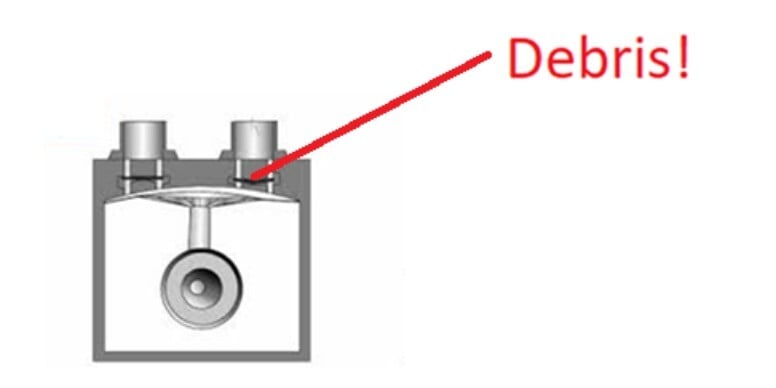
Avoid pump failures in IVD systems with FMI’s valveless design—ideal for handling viscous waste, debris, and complex fluidic challenges.